
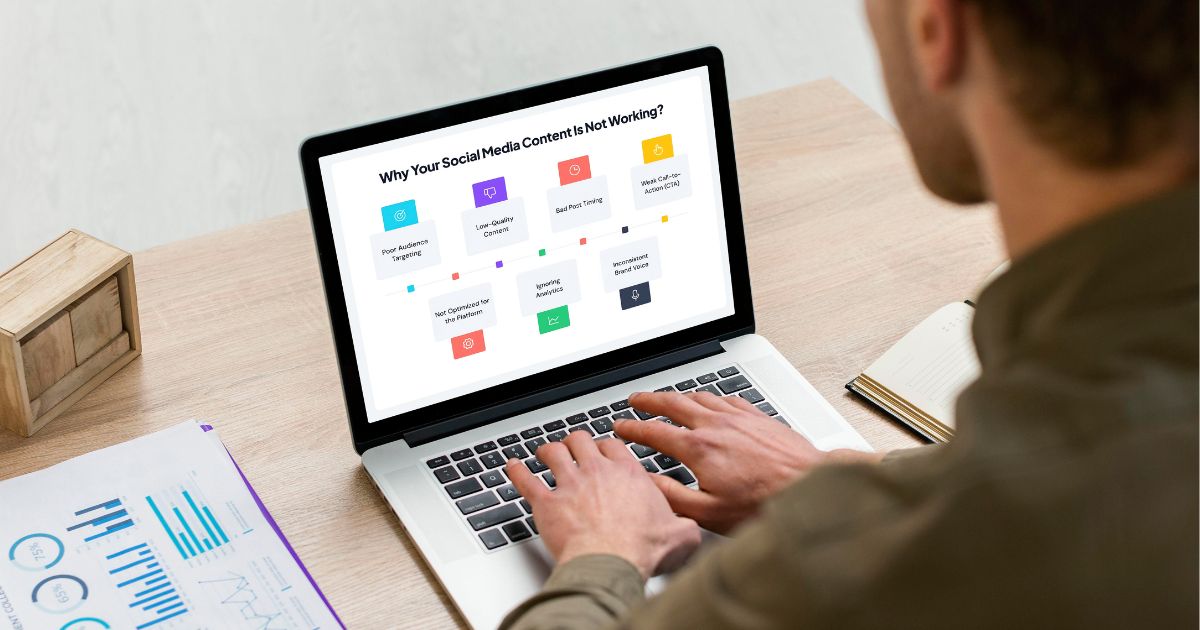
Social Media Content Engagement Failure Reasons Every Brand Should Know
 Published:
April 30th, 2026
Published:
April 30th, 2026

Low social media engagement is the result of common social media mistakes such as poor post timing, over-promotion, under-promotion, ignoring audience needs, and avoiding short-form videos.

Sahil Bansal
Founder & CEO
13 min read
A few years ago, posting regularly on social media was the key to gaining attention. Though the thought process in 2026 and the algorithm game have completely changed.
Consistency alone can’t guarantee social media success. AI understanding, social media scheduling tools, and templates have levelled up the social media field.
A study by “SQ Magazine” revealed that the time spent on social media has arisen now averaging 2 hours and 41 minutes per day.
Another study has shown that reach on social media platforms such as Facebook and Instagram decreased by 9% and 29%, respectively.
Social media is a mysterious creator that you can never figure out. Operating in a reactive mode, coping with changing trends, and understanding social media content engagement failure reasons can help you stand out among competitors.
What is Social Media Marketing?
In today’s digital-first world, social media marketing (SMM) is among the most powerful tools for brands to connect with their target audience and influence buying decisions. Social media marketing is the process of using platforms like Instagram, Facebook, LinkedIn, X, and TikTok to promote a brand and build engagement. It drives business growth through strategic content, creating a performance-focused social media strategy, and building audience interaction.
What Media Engagement Means for Your Business?
Research from Sprout Social suggested that customers expect brands to create interactive, authentic, and valuable content rather than relying purely on promotional posts.
Media engagement defines how actively your target audience interacts with your brand’s content across various social media and digital platforms. It includes likes, comments, shares, clicks, mentions, saves, and direct conversations that showcase audience interest and connection with your business. High engagement is a strong indicator that your content ideally resonates with the right audience and builds meaningful brand relationships.
Why Humanizing Your Marketing Content Matters?
Is your social media engagement rate showing a 0 percent analytics issue? If yes, you may not be focusing on humanised content.
The digital landscape has completely shifted. We have officially entered the relationship era. While the traditional marketing approach was dependent on one-way communication, today’s consumers’ demands are entirely different.
But how to grab social media attention with content that stands out? The answer to this question lies in following the human approach. Although AI content has revolutionised the way social media posts are made, human content still plays a pivotal role in social media engagement.
Humanised content serves a unique purpose. Today, consumers look for authentic relationships with brands. Consumers are more likely to engage with brands showcasing empathy and include an element of surprise. They look for content that looks more like a human rather than an advertisement.
Humanised content works on a slightly different approach. Rather than content that checks market boxes, it focuses on serving the target audience. The goal has shifted from “what do we want to achieve?” to “how can our business prove its intent about not making money but forming long-term relationships?”
Social Media Mistakes That Are Killing Your Engagement
Many businesses struggle with low engagement without realising that small content mistakes can drastically impact their reach and audience interaction. Working on these social media mistakes is vital to improve visibility, engagement, and long-term digital growth.
Content that Only Act as a Background Noise
Spoiler alert: the problem is not about the amount of content but the perspective behind that content!
One of the main reasons for low engagement in 2026 is publishing content that blends into an endless stream of unwanted or irrelevant posts. Audiences these days scroll through massive amounts of content, and generic posts that lack emotions, relevance, and originality often become background noise.
Content fails when it looks repetitive or similar to what every other brand is already posting. Users are more likely to engage with content that educates, informs, inspires, entertains, or solves a problem quickly. If a post does not capture attention within the first few seconds, most users scroll without interacting.
Moreover, in the absence of a unique brand voice, businesses post random trends without aligning them with their audience’s interests.
What To Do?
In 2026, social media algorithms prioritize content generating authentic interactions, watch time, saves, and shares. Low-value posts are less likely to appear in users’ feeds consistently.
To avoid becoming background noise, brands should focus on storytelling, creating audience-centric content, visually engaging formats, and posts that encourage engaging interactions.
Your Posts Lack Variety
Are you using the same post template? Or, using the same content format for all posts? If yes, your social media strategy needs immediate revamp. Posting the same type of content for months or years can add to repetition or boredom. This can push the audience away from your website.
What to Do?
Planning and brainstorming new content ideas would be a great way to transform your content strategy in 2026. You can also design content calendars and align your content in a way to capture the audience’s attention.
Ignoring Audience Insight
Ignoring audience insight is a critical social media content engagement failure reason for many brands. Top brands or even the growing ones create content based on assumptions instead of understanding the target audience’s intent, tastes, and preferences. Hence, the content feels scattered, disconnected, and unable to capture attention.
Audience insights help businesses analyse key factors, including audience interests, behavior, active formats, preferred content formats, demographics, and engagement patterns. Without apt data, brands post content that may not align with user expectations. Thus, leading to low reach and declining engagement rates.
Modern social media platforms rely heavily on user behavior signals. If audiences quickly scroll past content without interacting, algorithms interpret it as low-value content and reduce its visibility further. This creates a cycle where poorly targeted content continuously underperforms.
What To Do?
In 2026, successful brands primarily focus on data-driven content strategies by analyzing engagement metrics, audience feedback, and platform analytics regularly. Businesses that actively listen to their audience can create more customised, relatable, and engaging content that strengthens customer relationships to improve overall social media performance.
Not Posting At the Correct Times
You may be wondering: “What is the right time to post on Facebook’? Or, “ When to post on Instagram?.
The correct answer is dependent on parameters such as audience behavior, industry, and platform algorithm. There is no universal posting time that guarantees high engagement for every business.
Different audiences from different states and countries are active at different times. For example, B2B audiences on LinkedIn engage more during working hours. However, Facebook and Instagram users are more active during lunch breaks or weekends. Posting when your audience is inactive can significantly reduce reach, visibility, and interactions, no matter how good the content is.
What to Do?
In 2026, social media algorithms prioritize early engagement signals. If your post receives likes, comments, shares, or saves shortly after publishing, your posts are pushed to a wider audience. However, posting at the wrong time may make your content get buried before your followers even see it.
Therefore, businesses should regularly analyze platform insights to identify when their target audience is most active. Testing alternate posting schedules, monitoring engagement patterns, and adapting content timing can help improve visibility and analyse customer behavior.
Not Using Call-To-Actions
Social media is a way to enhance your brand awareness and overall website traffic. Though if your content fails to add a call-to-action, your content will not get better conversions. The reasons why your CTA fails are:
- Fluff content that looks incomplete or messy.
- Ignoring audience intent or needs.
- Adding senseless or many CTAs.
What to Do?
Call-to-action is a great way to add engagement and push potential customers to take an action. Only use CTAs that are effective and apt for your website content. Adding so many CTAs may make your content look messy.
Over-promoting your Content
One of the biggest reasons behind low engagement is bad or excessive self-promotion. Many businesses rely heavily on selling products or services in every post. This can make their content feel repetitive, less valuable, and intrusive to audiences. Modern social media users prefer authentic, informative, educational, entertaining, and relatable content rather than merely using promotional messages.
When every business post revolves around discounts, offers, sales pitches, or direct advertising, your target audiences start ignoring the brand altogether. Over-promotional content often reduces trust and limits meaningful interactions as active users feel they are forcibly pushed towards buying your product.
Social media algorithms these days only favor content that motivates conversations, shares, watch time, and community interaction. However, posts that appear overly sales-driven generally receive lower engagement signals. Therefore, reducing a brand’s organic reach over time.
What to Do?
In 2026, successful brands follow a balanced social media content strategy by combining educational posts, storytelling, customer experiences, behind-the-scenes content, and interactive formats with promotional campaigns. Businesses dependent on delivering value-driven results are more likely to build stronger audience relationships and achieve higher engagement rates.
Under-promoting Your Content
2026 is a year of forming value-driven relationships with audiences. Creating high-quality social media content is not merely about a few people actually seeing your content. A big engagement mistake businesses make in digital-first marketspace is under-promoting their content and relying entirely on organic search reach.
Even high-quality posts can fail to perform when brands publish content once and never amplify it again. Social media platforms have become highly competitive as thousands of posts fight daily for audience attention. If businesses do not actively distribute their content through stories, collaborations, communities, hashtags, reposts, or paid promotion, a brand’s visibility often remains limited.
Many brands spend hours creating content, but only dedicate a few seconds to promoting it. As a result, valuable posts disappear quickly in crowded feeds before reaching the right audience. Low initial visibility impacts engagement signals, reducing the chances of the algorithm pushing the content further.
What to Do?
In 2026, successful social media strategies are not only centred around content creation but also on strategic content distribution. Brands that consistently repurpose, reshare, or promote their products and services across multiple channels are likely to increase website reach, improve engagement, and maximise long-term content performance.
Not Investing in Short-Form Videos
Prioritising short-form videos is the need of the hour. Platforms like Instagram Reels, Facebook Reels, TikTok, and YouTube Shorts continue to rule social media engagement as audiences prefer fast, visually engaging, and easily consumable content. However, brands that only depend on static or lengthy content struggle to capture user attention in crowded feeds.
Meta has shifted its platform strategy heavily toward video-first content. Facebook and Instagram algorithms are prioritising reels and short-form video formats because they generate higher watch time, shares, and audience retention. As a result, businesses that fail to invest in short-form videos may experience declining reach and low engagement over time.
Short-form videos assist brands in communicating messages quickly while improving visibility, discoverability, and audience interaction. They are effective for storytelling, product demonstrations, behind-the-scenes content, trends, educational tips, and brand personality building.
What to Do?
In 2026, social media success is much more than posting regularly, but about creating content in a format consumable by the audience. Businesses that adapt to Meta’s growing focus on short-form video content are more likely to stay relevant, increase engagement, and strengthen their digital presence.
Wrapping Up
Social media engagement doesn’t decline overnight; it happens when you don’t analyse social media content engagement failure reasons and repeat your mistakes. From ignoring audience needs and posting at the wrong times to over-promoting or under-promoting your content and avoiding short-form videos, each factor impacts how users interact with your brand online.
Our social media management services are known to help your content reach its target audience. We don’t just craft social media posts but deliver long-lasting results. Our experts undertake an in-depth analysis of your needs, customer behavior, social media trends, and your business objectives to craft a social media strategy.
Frequently Asked Questions
Related Posts
Micro Influencers vs Macro Influencers: What Brands Need to Know
Micro influencers offer higher engagement and niche trust, while macro influencers provide wider reach and visibility for large-scale brand awareness.
By Sahil Bansal

User Generated Content (UGC) Marketing: What It Is and Why Brands Use It
User Generated Content (UGC) marketing uses customer created photos, videos, and reviews to build trust, boost engagement, and increase brand awareness.
By Sahil Bansal
Best Time to Post on Instagram in 2026: A Complete Guide
9 AM–11 AM, 12 PM–2 PM, and 5 PM–7 PM are widely considered the most effective global engagement periods across major Instagram audiences in 2026.
By Sahil Bansal